March 2026 Poll on Latinos, Trump, and Immigration (c3)
.png)

Methodology: This memo summarizes key findings from a national poll of 2,000 registered Hispanic voters, conducted from March 10 to 20, 2026, as well as a national poll of 400 registered non-Hispanic voters, conducted from March 10 to 15, 2026. The Hispanic poll has a margin of error of ± 2 pp. The non-Hispanic poll has a margin of error of ± 4.9 pp.
Trump’s job approval among Hispanics has remained stable since last summer. Though the salience of immigration has decreased in the wake of the war in Iran, underlying attitudes toward Trump's enforcement policies remain sharply negative — and while Latinos are still more likely to approve of his handling of the border than his handling of immigration overall, they reject his interior enforcement approach by wide margins. Ultimately, what most Americans – including Latinos – want is (1) protection for families, children, U.S. citizens, and legal immigrants; (2) accountability when ICE agents go too far; and (3) enforcement that targets genuine threats without tearing families apart.
1. Latino Trump approval remains stable since last summer.
Among Hispanic respondents, Trump’s net job approval is at -25 (35% approve, 60% disapprove) and has remained stable since the summer of last year. Net Trump approval is lower among Latinos (-25) than non-Latinos (-15).
2. The salience of immigration has declined following the war with Iran, but remains an important issue for Latinos.
Immigration dropped sharply as a top issue for Hispanic respondents – from 27% in February to just 8% today – as the economy (up from 35% to 44%) and the war with Iran (up from 5% to 18%) became more top-of-mind. But while salience has shifted, attitudes on the issue have not. Latinos continue to strongly reject Trump's approach to immigration enforcement, and with the administration showing no signs of slowing down, the issue is likely to surge back into the headlines – making Latino attitudes on immigration incredibly important to understand.
3. Most respondents believe Trump has gone too far on immigration, primarily because of the impact his broad approach has had on families and children, as well as U.S. citizens and legal immigrants.
Net approval of Trump’s handling of immigration among Hispanic respondents is -26 (35% approve, 61% disapprove), significantly worse than what we’re seeing among non-Hispanics, where net approval is -4 (47% approve, 51% disapprove).
By a wide 65-30 margin, Latinos believe Trump’s actions on immigration “are going too far, and instead of deporting criminals, he is targeting the types of hardworking immigrants who strengthen our nation,” ahead of believing his actions are “justified… If some people who are not criminals suffer because of it, it's the price to pay to ensure our safety.” Non-Latinos are more likely to describe Trump’s actions as justified (43%), but a majority still say he has gone too far (53%).
Among Latinos who believe Trump's actions on immigration have gone too far, the majority cite either the separation of families and detention of children (42%) or the detention and deportation of U.S. citizens and legal residents (26%), rather than the impact on the economy (19%), as their reason for thinking so. The impact on children and families ranks highest among Latinos and is cited by the plurality of non-Latinos as well.
4. Hispanic respondents largely believe Trump is targeting all undocumented immigrants – not just the dangerous criminals he had promised to focus on.
A majority of Hispanic respondents (62%) believe Trump is trying to deport as many undocumented immigrants as possible, regardless of their criminal background or how long they’ve been in the U.S. Just 12% believe he is only deporting recent arrivals or those with a criminal record. And 22% say he’s trying to target only recent arrivals and those with a criminal record, but some of his efforts have affected other undocumented immigrants.
5. Approval of Trump’s handling of the border continues to outpace his approval on immigration broadly, but enforcement overreach is more top-of-mind for respondents today than uncontrolled border crossings.
While Latinos seem to be rejecting Trump’s approach to interior immigration enforcement, his handling of the border remains one of his areas of relative strength. On border security specifically, net approval among Latinos is at +1 (48% approve, 47% disapprove), compared to -25 overall and -26 on immigration. Among non-Latinos, net approval on the border is at +9 (51% approve, 42% disapprove).
But concerns related to the border are not top-of-mind for respondents. Just 7% of Latinos and 9% of non-Latinos say the most urgent problem with the U.S. immigration system today is uncontrolled immigration across the U.S.-Mexico border. A plurality (33%) say the most urgent problem is that immigration enforcement policies like detention and deportation have gone too far. Non-Latinos are more likely to say the most urgent problem is that there are too many undocumented immigrants currently living in the U.S. (31%) compared to Latinos (20%), but the same share cites enforcement overreach as the most urgent problem (33%).
6. Most Americans, including Latinos, want to see meaningful changes to how ICE operates – not an end to immigration enforcement.
Strong majorities of both Latinos and non-Latinos want to see meaningful changes to immigration enforcement. Nearly 3-in-4 Hispanics (72%) want to see changes, whether that means they support reforming ICE to prevent violence and ensure accountability (37%) or abolishing ICE because it is out of control and no training or accountability could reform it (35%). A majority of non-Hispanics (64%) also want to see meaningful changes to immigration enforcement, with half supporting guardrails (32%) and the other half supporting abolishing ICE (32%). Non-Latinos are more likely to say ICE should continue to operate as-is compared to Latinos (35% vs 25%), but most Americans support a change from the status quo.
The vast majority of respondents who say ICE should be abolished say that means there should be a different approach to immigration enforcement, not an end to it entirely. Among those who believe ICE should be abolished, 85% of Hispanics and 82% of non-Hispanics say that this should mean either redirecting ICE funds to other agencies (47% for Latinos and non-Latinos) or starting a new immigration enforcement agency (38% of Latinos, 35% of non-Latinos). Just 14% of Latinos and non-Latinos who say they think ICE should be abolished believe “there should no longer be any form of immigration enforcement.”
7. A “back to basics” message that centers safety and opportunity outperforms an “abolish ICE” message, particularly among non-Latinos and Latinos who support reforms for ICE.
When tested against White House immigration talking points, 64% of Hispanic respondents say a “back to basics” message comes closer to their view, compared to 58% who pick an “abolish ICE” message.
Abolish ICE: It's time to abolish ICE. ICE is supposed to be enforcing immigration law, but instead, is terrorizing people no matter their immigration status, no matter the facts of the law, and no matter the facts of the case. ICE has harmed and killed too many people, including U.S. citizens. We should shut down the agency and replace it with something that will actually keep our communities safe.
Back to Basics: It’s time to get back to basics on immigration. America has always been a land of opportunity, a place where people who work hard have a chance to build a better life. The government's responsibility is to keep our communities safe, so that hardworking Americans can focus on getting ahead. On immigration, that means focusing enforcement where it belongs: on removing violent criminals and serious threats, while protecting the promise and opportunities that define this country.
The “back to basics” message is especially strong among non-Hispanics, where 65% pick the “back to basics” message over the White House message, compared to just 49% for the abolish ICE message.
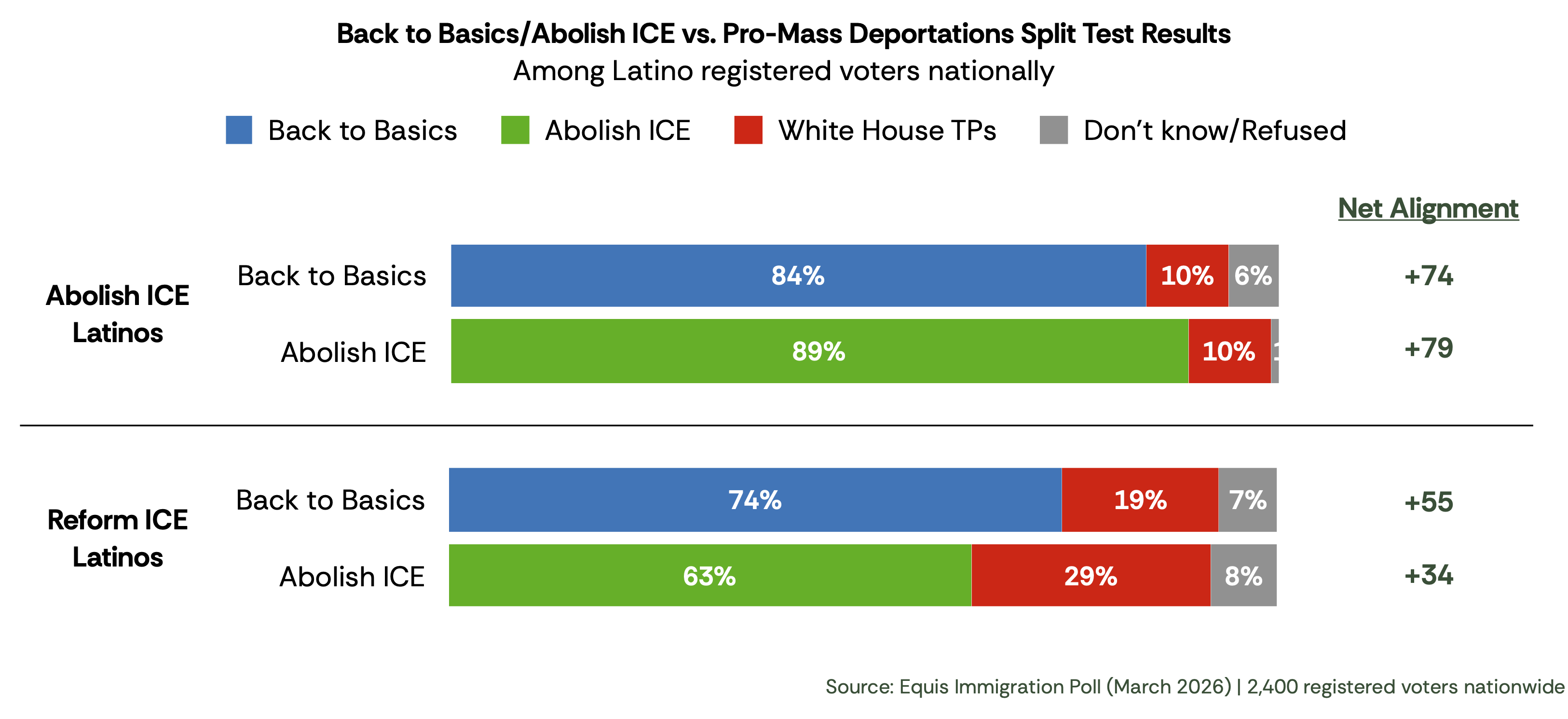
Most importantly, the “back to basics” message generates support from both those who believe ICE should be abolished and those who think the agency needs to be reformed, while an abolish ICE message has more narrow appeal. The “back to basics” message generates similar levels of support from those who support abolishing ICE compared to the “abolish ICE” message (+74 vs +79, respectively), and it gets significantly more support from those who believe ICE should not be abolished but needs additional guardrails (+55 vs +34, respectively).
We work toward a more sophisticated understanding of the experiences, issue preferences, and political identities of Latino and Hispanic voters.

Equis is a set of organizations working to create a better understanding of Latinos, innovate new approaches to reach and engage them, and invest in the leadership and infrastructure for long-term change and increased engagement.