2026 Election Day Memo: Latino Voters


In the modern political era, midterm elections almost always move against the president’s party, and this year will be no exception. Nationally, all signs point toward a strong performance by the Democrats on November 3. They will almost certainly win back the House, and the Senate is within reach. The question is: will it be a good night or a great night for the Democrats? A blue wave or a blue tsunami? Expect some unexpected results, but the winds of change are clearly blowing in favor of the Democrats this year.
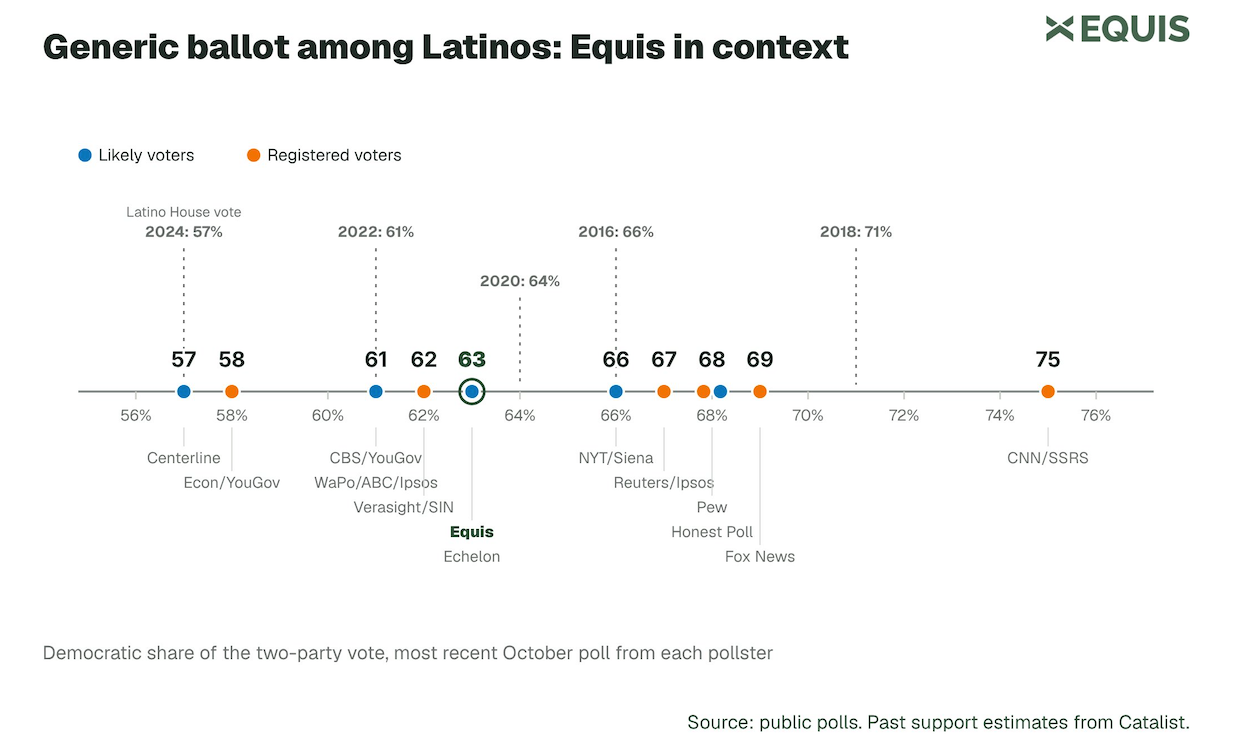
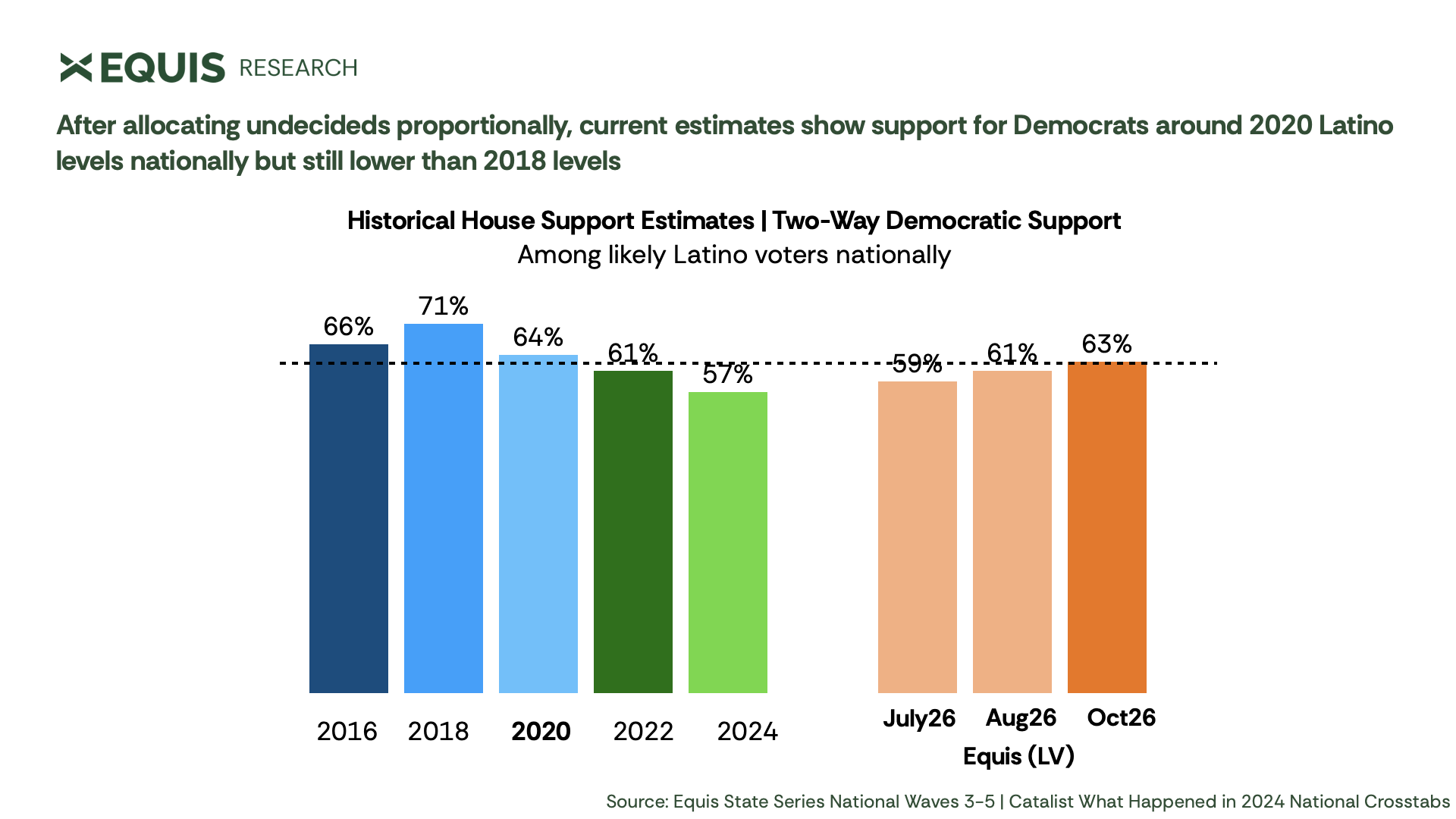
Democrats are poised for a meaningful rebound with Latinos, one that has already reshaped the electoral map, putting states like Texas into play and potentially frustrating GOP redistricting efforts. Nearly all recent public polls show an improvement over Harris’s performance with Latinos in 2024 (54% two-way support nationally, according to Catalist), including the final Equis pre-election poll, which put Democrats at 63% in the generic congressional ballot (GCB) among likely Latino voters nationally.
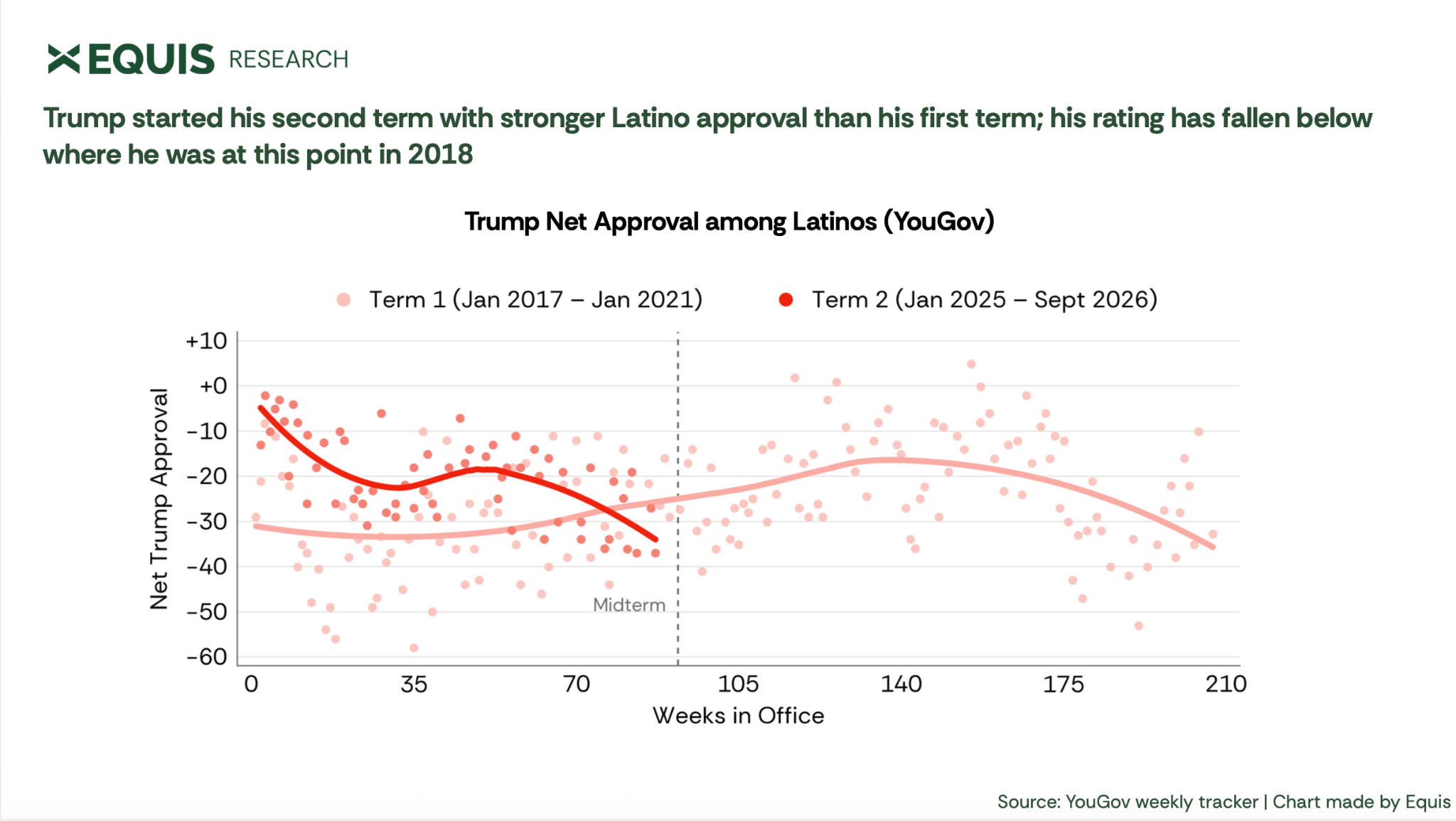
Much of the credit goes to Trump himself: he has consistently delivered the opposite of what many of his voters, including Latinos, wanted on the economy, immigration, the war with Iran, and more. The throughline is a pervasive sense that the president has broken his promises and is focused on the wrong priorities. By August, disappointment and regret among Trump’s 2024 Latino voters had reached an all-time high (43%) in Equis polling. Trump is now more unpopular with Latinos than he ever was during his first term.
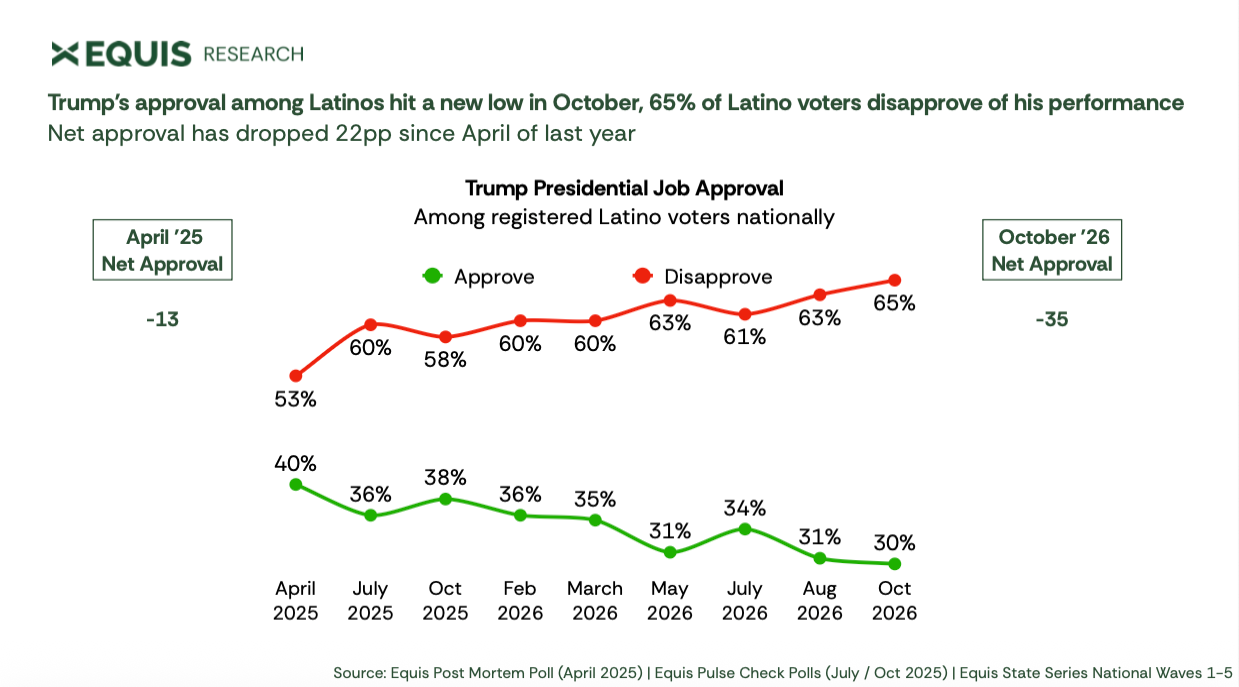
In Equis polling from October, 65% of Latinos disapproved of Trump’s performance, while just 30% approved.
Notably, the war with Iran and the ensuing spike in gas prices have hit Latinos particularly hard. For one thing, Latinos are especially sensitive to gas prices. For another, Latinos are more opposed to prolonged foreign conflicts than other Americans, and more likely to say the U.S. should focus on problems at home. Phillip, a Cuban Trump voter from New Mexico, described the impact of Trump’s broken promises in stark terms:
“President Trump was running saying he was gonna get gas prices down, groceries prices down, he hasn’t done any of that. He’s taken healthcare away from everybody. Gas prices are up. Grocery prices are up. But his priorities are somewhere else. He wants to rule other countries instead of focusing on us. The war to him is more important than us, we’re not on his radar at all. We could die, we could struggle, and he won’t care.” 1
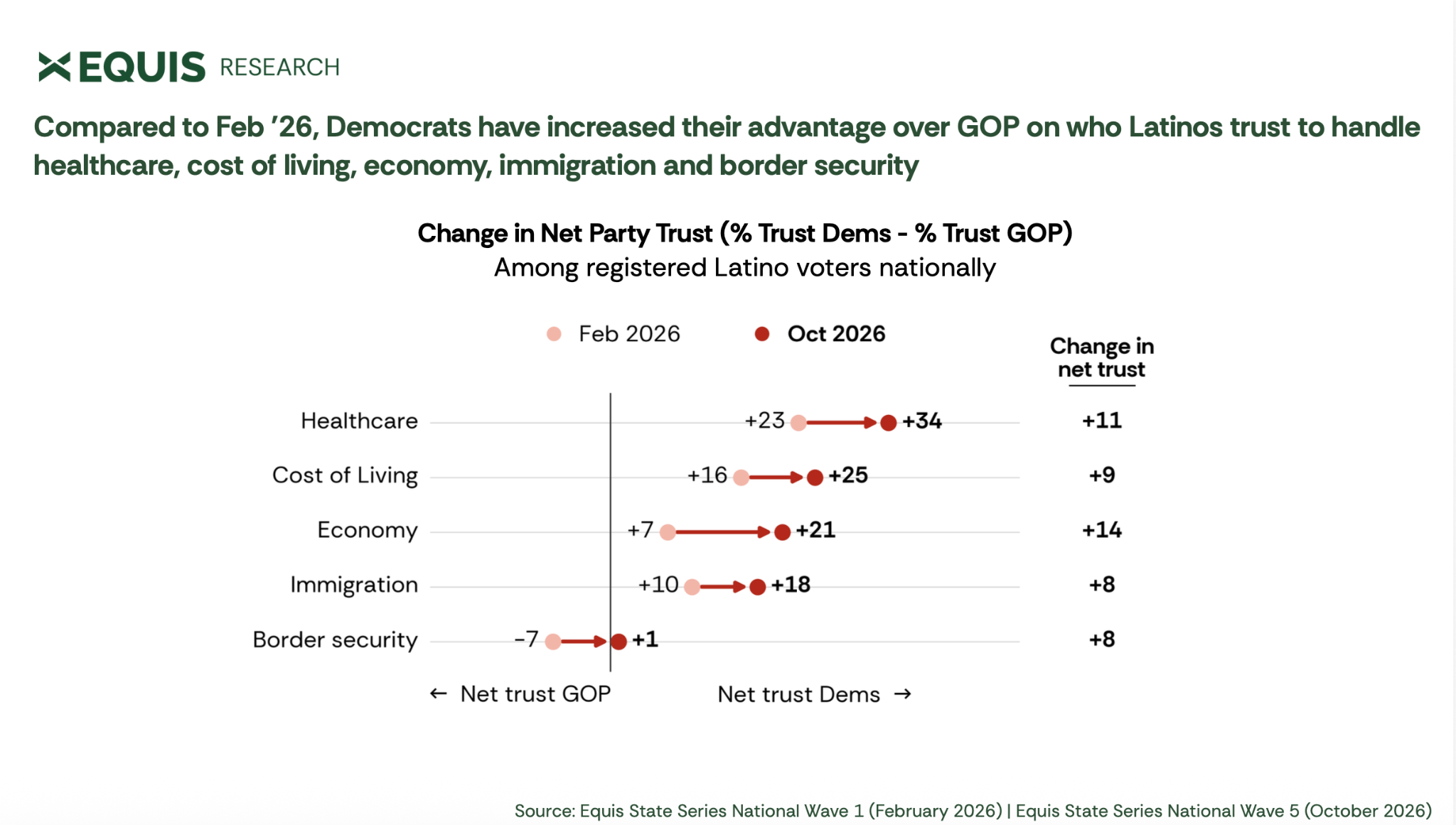
The administration’s deportation agenda has also played an undeniable role in shifting Latino voter sentiment, including among Trump's own supporters – most of whom (66%) believed that he would narrowly target enforcement on new arrivals and violent criminals. The contrast between what many Latinos expected from Trump and what they got has helped feed the narrative of broken promises. It has also pulled attention away from the border and toward the impact of broad deportations on long-term residents, especially families and children. That shift matters, because Republicans are more trusted on the border than on immigration overall. Currently, Latino registered voters are split on which party they trust more on the border, but give Democrats an 18-point advantage on immigration, a gap that has increased by 8 points (from +10 to +18) between February and October of this year.
Historical context is critical for diagnosing how far Democrats have wound back the clock with Latinos. In the Trump era, 2024 represents the low point and 2018 the peak of Democratic support among Latinos. 2020, when Trump and Republicans made their first major inroads with Latinos outside Florida, and 2022, when the GOP largely held onto those gains in spite of a “red wave” that fizzled, fall between the two extremes. Equis will be gauging Democrats’ performance relative to these benchmarks.
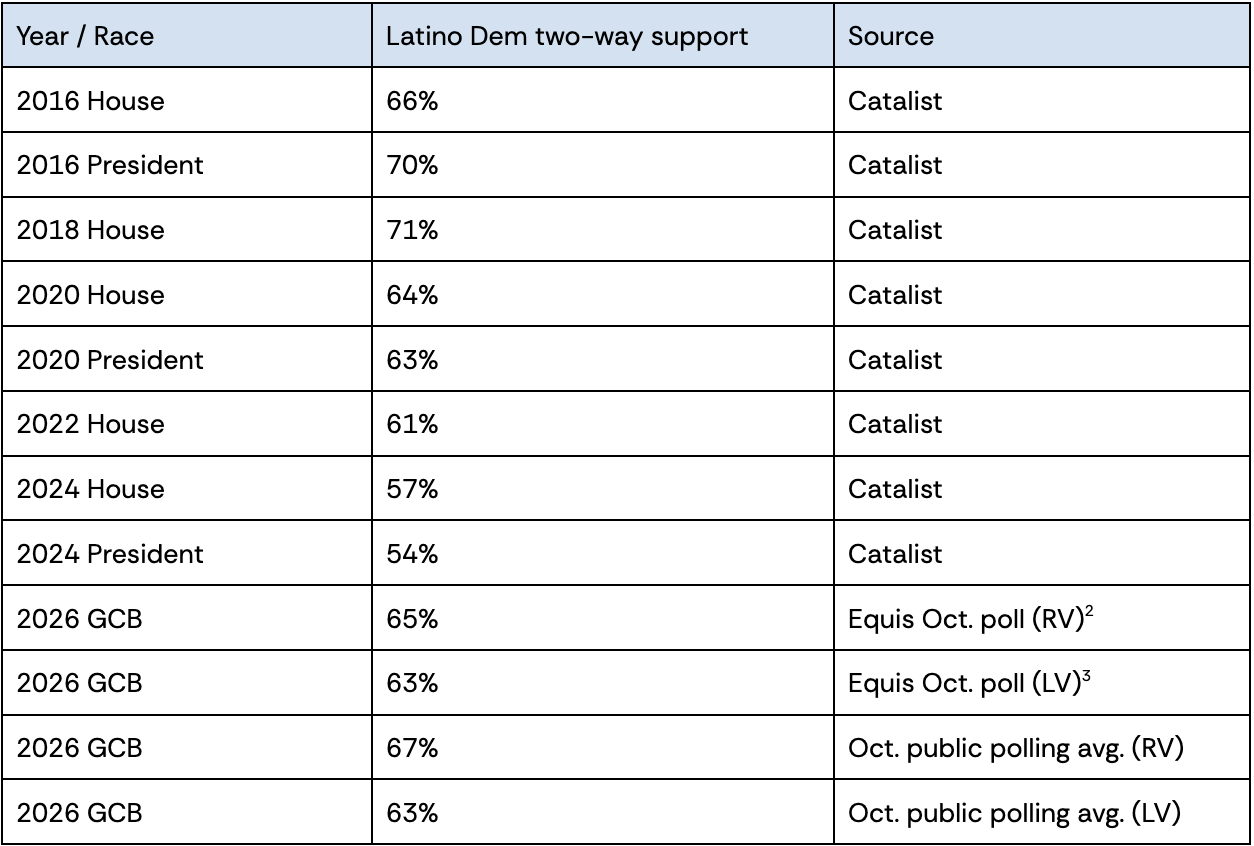
The final Equis pre-election poll put Democrats around their 2020 levels of support. The ultimate result depends on factors that have yet to be fully determined, including the composition of the midterm electorate and the turnout differential between the two parties. A range of outcomes remains possible. Whether Democrats have a good or a great night with Latinos depends not just on whether they can reach or surpass previous highs in key geographies, but also on how shifts in Latino support and turnout compare to other groups in the electorate.
Trump’s 2024 support levels among Latinos reflected gains accrued over multiple elections and are unlikely to be fully erased in one fell swoop, however unpopular Trump himself is at the moment. The Equis 2024 post-mortem analysis showed that while many Latinos remain persuadable, a substantial segment of Trump’s Latino supporters looked likely to stick with the GOP. Peeling those people away is likely to require more than dissatisfaction with the president alone. A common mistake in recent elections has been to read each new Latino swing as a permanent new direction, rather than as evidence of continued fluidity. Even if Democrats have a great night with Latinos, elements of the MAGA narrative have shown a durable resonance with a segment of Latino voters that could be reactivated in the future.
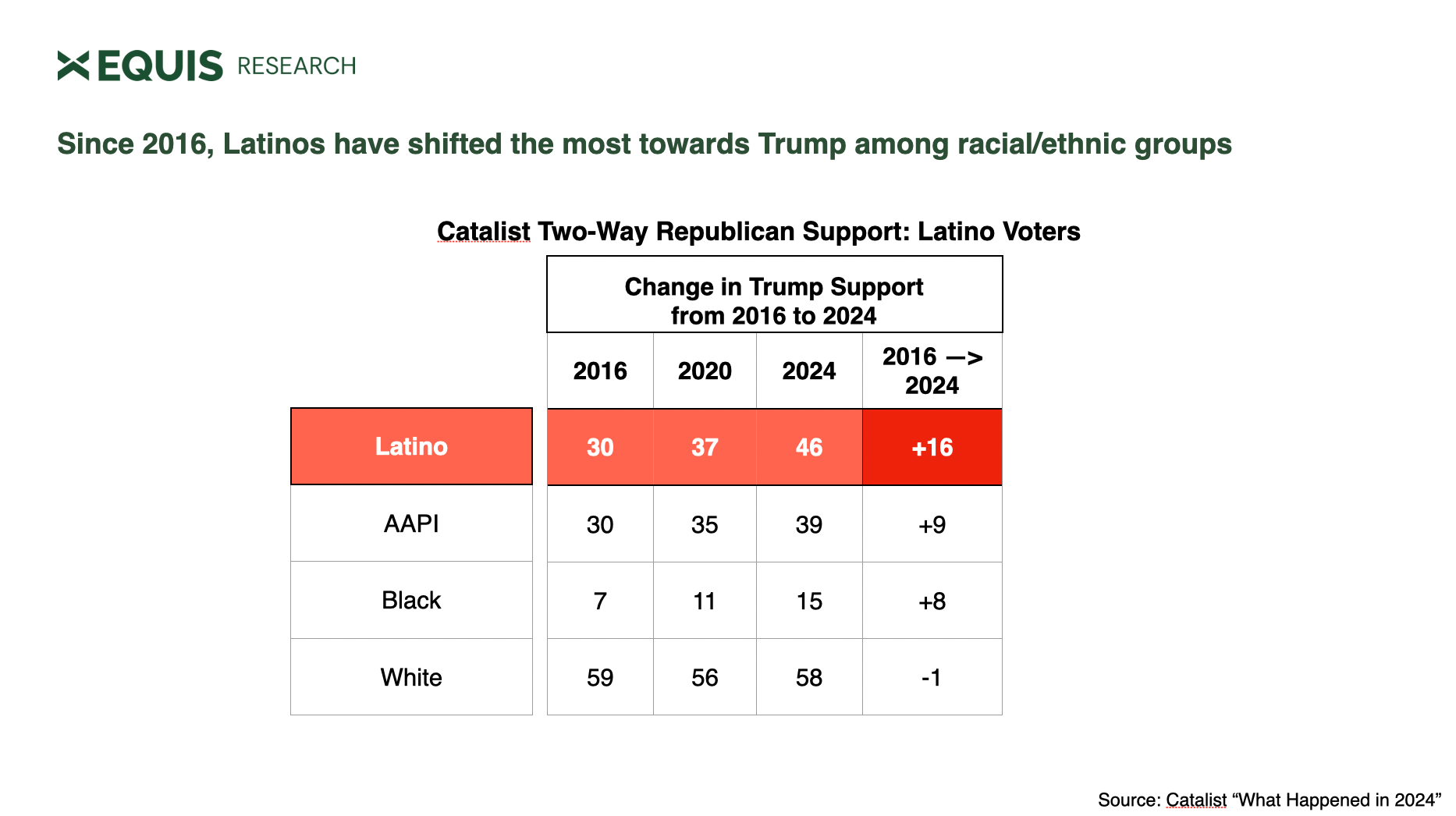
What to expect: significant variation in the size of the Democratic rebound across races and geographies. Identifying where the highs and lows are will be an important part of telling the story, and learning the lessons, of this year’s election. On election night itself, it is important not to read too much into any single data point or result, especially the early ones. A cautionary tale from Florida: even in the blue wave of 2018, Florida Latinos swung toward Republicans.
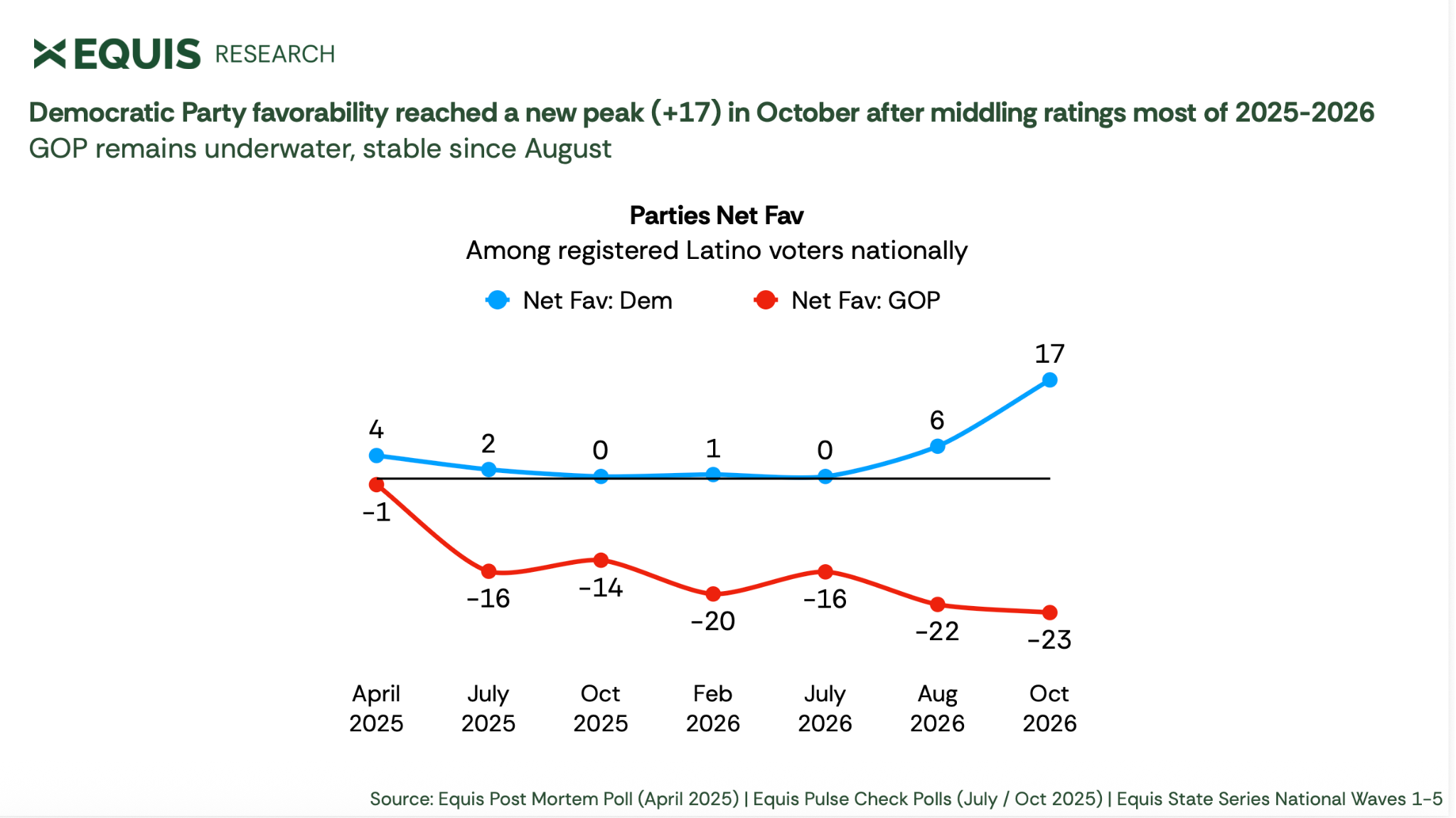
While disappointment with Trump and his party is the driving force of this midterm election, Democrats have also improved their standing with Latinos: in the last few months, the party’s favorability rating has improved after a long period of stagnation, going from an even split in July to +17 net favorability in October.
Trust in the Democrats has also increased across issues, especially on the economy and health care. But it remains to be seen how durable those gains are, especially if perceptions of the economy begin to improve under Trump. In part, that durability will depend on what Democrats do with their wins in 2026 as they regain some governing power. Democrats have significant work to do to rebuild their brand with Latinos, and two potential pitfalls stand out. One is being seen as focused on the wrong priorities. The other is overpromising and underdelivering, which would reinforce the perception that Democrats can’t be counted on to get things done.
The post-Trump era is approaching. The results of this midterm will inevitably be interpreted through the lens of what they mean for the upcoming primaries and the presidential election in 2028. There will also be voices urging caution about generalizing from a midterm to a presidential. Equis will likely be doing some of both. One important thing to keep in mind for Latinos in particular: the 2028 presidential election will bring many new voters into the electorate, and Latinos are likely to see an even higher degree of churn than other groups. These new voters can counteract previous trends, or accelerate them. In the search for lessons that 2026 may hold for 2028, paying attention to trends among all eligible Latino voters, including new and non-voters, will be a key part of the picture. The last few election cycles have shown that Latinos are this era’s most important swing bloc. They’re not anyone’s to win or lose by default.
1 Equis, “Beyond the Ballot” [2026]
2 Registered Voters (RV)
3 Likely Voters (LV)
We work toward a more sophisticated understanding of the experiences, issue preferences, and political identities of Latino and Hispanic voters.

Equis is a set of organizations working to create a better understanding of Latinos, innovate new approaches to reach and engage them, and invest in the leadership and infrastructure for long-term change and increased engagement.