Memo: October 2026 National Poll
.png)

The Midterm Election
Weeks before the midterm election, Democrats are up 26pp among Latino voters, their widest lead of the cycle on the generic congressional ballot (57%-31%), up from a 22pp lead in August. Among likely voters in competitive congressional districts, two-way support for Democrats is at 62% after allocating undecideds proportionally, landing ahead of 2022 support levels (~57%) for the first time this cycle, but not reaching the peak of 2018 (~67%).
.png)
Movement away from Republicans among Latino Trump voters has steadily increased in the past year. In October 2025, 86% of Latino Trump voters said they would support a Republican on the generic congressional ballot. Today, GOP support is at 76%, with 13% of Trump 2024 voters saying they will vote for a Democrat and 11% undecided.
.png)
Perceptions of Trump & the Parties
After middling ratings since the summer of 2025, the Democratic Party has earned positive favorability among Latinos in the two most recent waves of national Equis polling: 54% favorable to 37% unfavorable (+17). On the other hand, the GOP remains underwater among Latinos: 34% favorable to 58% unfavorable (-23)5, stable since August (-22). President Trump’s favorability continues to be lower than his party’s, with only 30% of Latino voters rating him favorably compared to 65% rating him unfavorably (-35). He receives an identical approval rating: 30% of Latino voters approve and 65% disapprove.
The Issues
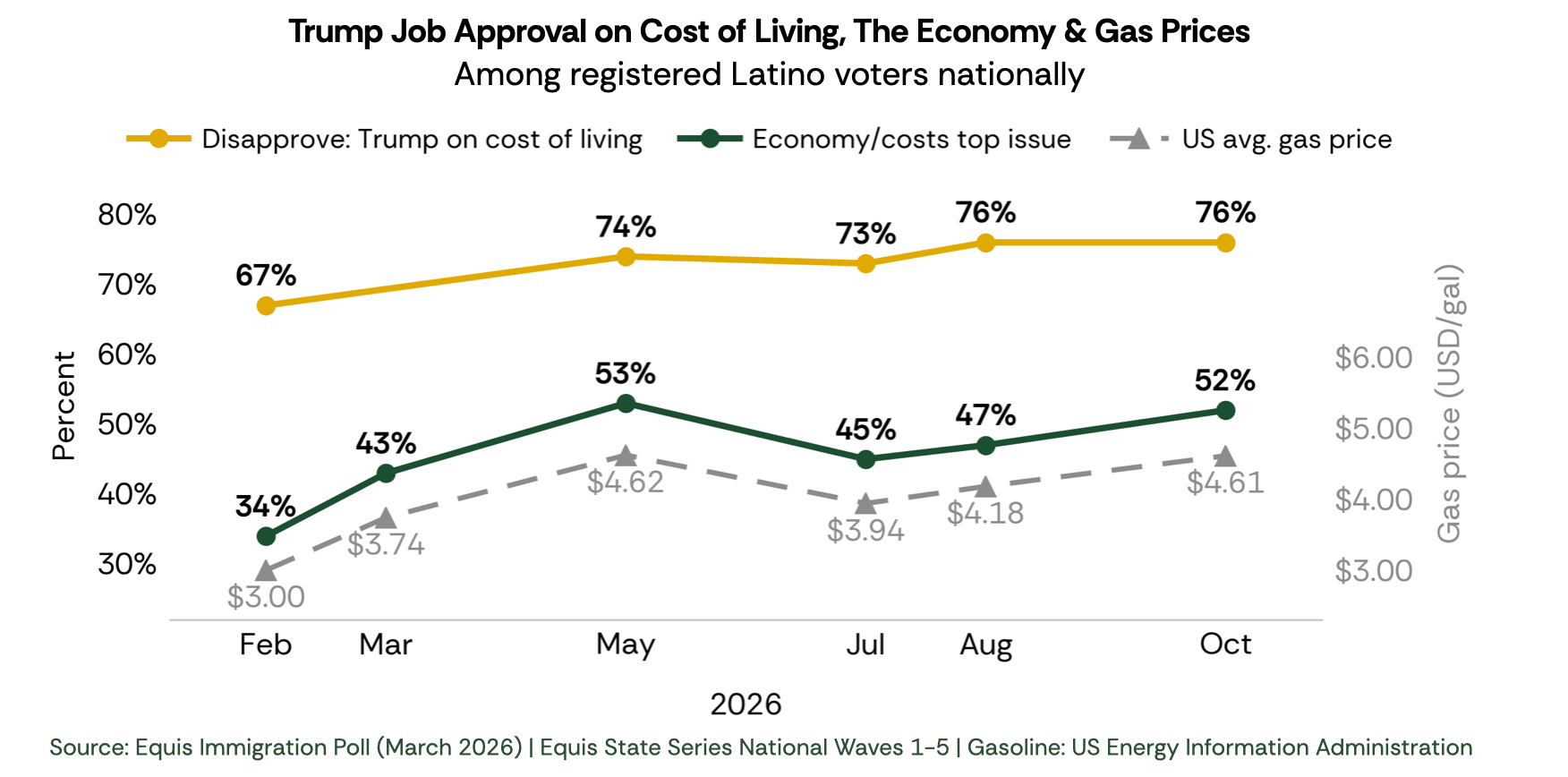
The economy and cost of living have consistently been the top issue for Latino voters – and President Trump’s worst performing issue areas – throughout the cycle. In an open-ended top issue question, about half of Latinos (52%) mention the economy and cost of living as the most important issue facing the country today, matching a previous peak in salience in May (53%). The rise of the economy and the cost of living as the top issue for Latino voters has closely followed the rise in average gas prices across the country. Trump’s approval ratings on these issues are also at low points: 73% disapprove of his handling of the economy and 76% on the cost of living – which has also tracked with gas price fluctuations.
The Democratic Party has increased its advantage on trust among Latino voters across key issues since February, including on former Republican strengths:
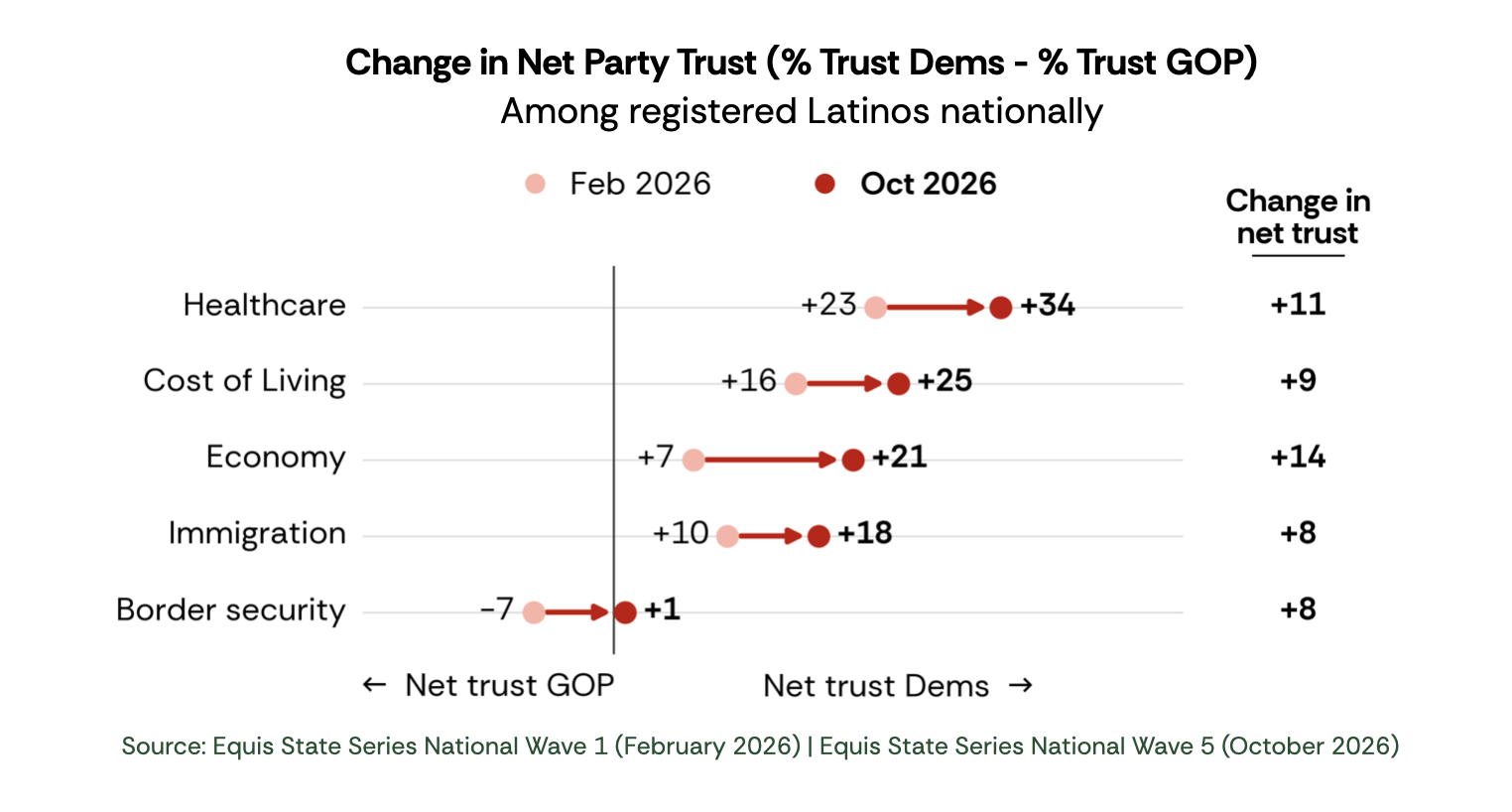
Overall, polling throughout the cycle points to a growing sense of disappointment in Trump and Republicans among Latino voters. Many who gave President Trump a chance in the 2024 election did so on the promise of a stronger economy and lower costs. Nearly two years later, economic pressures keep rising, and an overarching theme of broken promises drives dissatisfaction among Latinos. Recent Equis research shows that Democrats have an opportunity in the closing weeks to persuade Latino voters by messaging on Trump’s broken promises to lower the cost of living and put America First, and by offering an economic vision that centers working people and speaks to their priorities.
AI & Data Centers: Latino voters are more likely to trust Democrats (43%) than the GOP (25%) to handle AI and data centers, but nearly 30% of Latino voters don’t know which party to trust on the issue, or don’t trust either party. Previous Equis research shows that nearly three-quarters (74%) of Latinos agree that “AI data centers are responsible for raising the costs of utilities and must be better regulated.” A similarly high share (71%) agree that “AI will take away jobs and make it harder for future generations to be economically successful.” But Latinos are split on whether “building new AI data centers will create jobs and opportunities and allow the United States to remain competitive,” with 46% agreeing and 47% disagreeing. Latinos also have mixed feelings on the potential benefits of AI, with 42% agreeing and 50% disagreeing that “AI will create new industries that make future generations more economically successful.” Latinos are worried about AI’s impact on jobs and utility costs, but they express uncertainty about the potential benefits of AI and which party they trust to handle the issue.
DSA & Economic Policies: A strong majority (72%) of Latino voters believe the Democratic Party should embrace economic policies like healthcare for all, paid family leave for all workers, and high-quality free public education for all – economic policies that would address some of the key areas where voters are struggling the most. These are core tenets of the Democratic Socialists of America’s (DSA) platform, yet when presented explicitly as DSA policies, a slimmer majority (60%) of Latino voters believe the Democratic Party should embrace them. The penalty associated with the DSA brand is lower but still present among non-Republican Latinos: support for embracing these policies drops from 87% among non-Republicans to 80% when mentioning DSA explicitly.
The DSA receives a neutral favorability rating among Latinos overall (37% favorable, 35% unfavorable), with 28% unable to provide a rating. Self-identified independents rate DSA unfavorably (-13), but a majority (54%) report not knowing enough to say – suggesting plenty of room for definition in either direction.
Latinos currently have mixed feelings about the DSA and the brand carries a penalty, even among non-Republicans. But negativity about the brand is not the same as negativity about the policies themselves: when it comes to policies like healthcare, paid family leave, and high-quality free public education for all, there is strong support for Democrats to embrace them, even when they are explicitly associated with the DSA label.
The Equis State Series captures the complexities of Latino voters through national, state, and pooled congressional district polling, focus groups, message testing, and competitive ad spend tracking. The quantitative research is representative of critical geographies, has healthy sample sizes, mixed modes to reach harder-to-reach voters, and asks culturally relevant questions. Made possible by our sponsors, the program’s findings serve as a public utility for the ecosystem; by pooling resources, we produce more and better research, to avoid relying on a single poll or small subsamples.
This survey was conducted September 23 - October 2 via phones and text-to-web with 1,800 registered voters who identify as Hispanic or Latino nationally. The sample was weighted to match the composition of registered voters modeled as Latino by state, gender, age, education, vote history, voter registration date, VCH score, and 2024 vote recall. The sample was also weighted by age, education, 2024 vote recall by gender, congressional district, and geography, to match the composition of registered voters modeled as Latino in each state with a sample size over 200, as well as in the Mid-Atlantic region (DE, MD, PA, NJ, and NY) and the Southwest region (AZ, CO, NM, and NV). Language of interview, place of origin, education and other variables were monitored during the fielding. The survey was conducted in English and Spanish, according to the respondent’s preference. MoE is ±2.3 for the full sample.
1 AZ-01, AZ-02, AZ-06, CA-13, CA-22, CA-45, CA-48, CO-05, CO-08, FL-07, FL-09, FL-14, FL-22, FL-25, FL-27, IN-01, NJ-07, NJ-09, NM-02, NV-01, NV-02, NV-03, NV-04, NY-03, NY-04, NY-17, PA-07, PA-08, TX-15, TX-23, TX-28, TX-34, TX-35, VA-07.
2 Two-way support estimates proportionally allocate undecided voters.
3 Source: Catalist historical support estimates.
4 [SPLIT A] As you may have heard, there are some candidates running for office who support policies like healthcare for all, paid family leave for all workers, and high-quality free public education for all. Do you think the Democratic party should embrace these policies, or reject these policies?
[SPLIT B] As you may have heard, there are some candidates running for office who identify as Democratic Socialists. The Democratic Socialists of America or DSA support policies like healthcare for all, paid family leave for all workers, and high-quality free public education for all. Do you think the Democratic party should embrace these policies, or reject these policies?
5 Due to rounding.
We work toward a more sophisticated understanding of the experiences, issue preferences, and political identities of Latino and Hispanic voters.

Equis is a set of organizations working to create a better understanding of Latinos, innovate new approaches to reach and engage them, and invest in the leadership and infrastructure for long-term change and increased engagement.