Countering Anti-Trans Attacks Among Latino Audiences
.png)

Equis partnered with Trans Freedom Alliance, Global Strategy Group, and HIT Strategies on a series of research projects to identify effective strategies Democrats can use to counter Republican anti-trans attacks. It included online journals, focus groups, surveys, and RCT message testing. This memo covers the learnings from this research, highlighting results from Latino audiences, and includes context from previous Equis research on the issue.
Republicans have made trans issues a centerpiece of their culture wars strategy – not just by attacking trans rights directly, but by painting Democrats as extreme, out of touch, and more focused on protecting a marginalized group than on addressing everyday concerns that impact most Americans. That culture wars strategy has resonated with some Latinos. While gender identity and what is taught at schools are not top issues in polling – consistently coming in way behind the economy and other issues – the topic has popped up in Equis polling as a concern about Democrats and organically in our qualitative work.
This Republican narrative was landing in a political climate where many Latino voters already felt that Democrats were not prioritizing the right things, focusing too much on “fringe” issues, or protecting newly arrived immigrants instead of delivering on most voters’ everyday concerns.
The 2024 anti-trans attacks on Kamala Harris and the Democrats broke through for many. The GOP made Harris the face of their anti-trans attacks – spending millions on ads using language like “Kamala’s for they/them” to portray her as prioritizing trans people over other Americans. This fit neatly into the broader feeling among many swing Latino voters that Democrats were prioritizing issues that wouldn’t address their everyday concerns. In an Equis post-mortem survey, concerns about Democrats pushing trans issues too far was the top reason for respondents’ discomfort with the party’s leftward shift – higher than worries about race, crime, immigration, or free speech.
In 2024, and still today, it’s clear that Democrats have no clear counter-narrative. The GOP has landed a clear, values-driven narrative which casts Democrats as prioritizing fringe social agendas over everyday concerns while they emphasize protecting children, restoring traditional values, defending parental rights, and reasserting common sense in schools and public life. Democratic elected leaders and candidates must offer a compelling alternative.
Most voters, including Latinos, feel that trans issues are complex: though they want to be fair and respectful of people’s freedom to exist as they wish, Latinos are also worried about things like allowing minors to make irreversible healthcare decisions, unfairness in sports, and possible safety issues in bathrooms, especially as it relates to children. A lot of these concerns seem to stem from consistent framing and attacks from conservatives and Republicans, and a lack of clarity coming from Democrats on where they stand on it.
Research shows being exposed only to anti-trans attacks from Republicans without a Democratic response increases the perception among Latinos that Republicans care more about people like them by 14pp. Research also shows that perceptions of which party “cares more about people like you” is an important measure for understanding - and changing - voter attitudes and behavior, so a shift of this size on this measure of care is significant.
This requires elected officials and candidates to take action to respond and define themselves on the issue in a way that allows voters to see they are reasonable, they take these concerns seriously but are not overly-focused on it, and are instead focused on the safety and wellbeing of everyone.
Focus vs Extreme
Voters’ perception of a political party’s approach on trans issues has two facets: how much a party is perceived to be focused on the issue, and how extreme a party’s position on the issue is perceived to be.
Attacks from Republicans, as well as Democratic support for inclusionary policies in blue states, make voters, including Latinos, see Democrats as overly-focused on trans issues (+36 among Latino men, +40 among Latina women).
Latino voters, however, also believe that Republicans tend to have more extreme views on trans issues compared to Democrats (-6 for Latino men and Latina women).
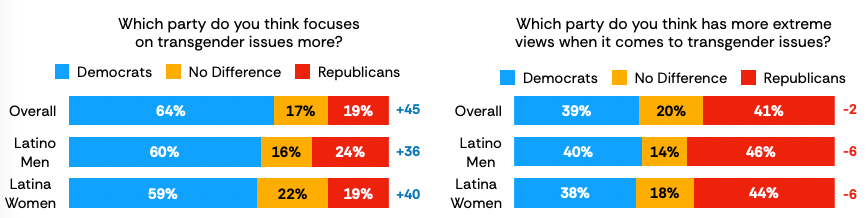
In online discussion journals, Latinos felt that neither party fully represents voters’ views on trans issues. Many believed both parties were too extreme. Democrats were stronger on policies related to transgender adults (including letting adults make their own healthcare decisions as long as care isn’t taxpayer-funded, and leading anti-discriminatory efforts around housing and job stability). However, when the issues at hand were about kids, voters moved away from the Democratic party. Democrats also suffer from being seen as pandering, weak, and perpetually on defense on the issue.
Latino voters want candidates and elected officials to focus on the issues that matter most to them – the economy, the cost of living, and safety for them and their families.
This calls for a Democratic narrative that reaffirms their commitment to improving the lives of all Americans and also shows they are focused on the things that voters, including Latinos, care about most.
How to Respond
Frame messaging to Latinos around Republicans’ wrong priorities and the human and everyday impact they have on all of us.
Use proof points that show economic waste and highlight the real cost of Republicans focusing on trans issues instead of more salient issues like the cost of living.
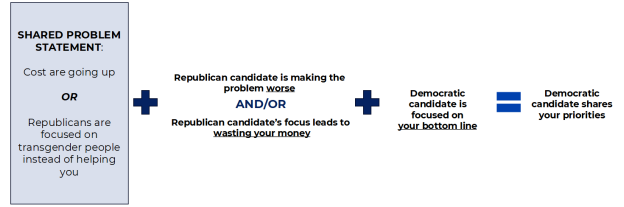
One way to call out waste and misplaced priorities is focusing on the misuse of tax dollars on trans-related issues such as investigations on healthcare workers, the passing and enforcement of anti-trans laws, and the defunding of public-use entities or programs that all people benefit from, like hospitals, to force anti-trans issues. For Latino voters, who like all voters, care deeply about the economy and are feeling significant economic pressure right now, calling out this waste of taxpayer money can be an effective way to highlight Republicans’ misplaced priorities. In message testing, Latino support for the Democratic candidate increased by 9pp after seeing the Example 1 message:
Example 1: “From gas to groceries, from electricity to healthcare, everything is more expensive. And what’s [Republican candidate] doing about it? Attacking our transgender neighbors. Adding to the $220 million Republicans have spent on negative television ads about it and more than $100 million taxpayer dollars wasted on restrictions on the 1% of Americans who are transgender. He’s not about you. He’s about extremes. [Democratic candidate] has a better idea. He’ll work to lower prices for working families like us.”
Example 2: “The cost of living is skyrocketing, but Republicans are more focused on
restricting the rights of transgender people than helping to solve our problems. Republicans have already wasted over $100 million of our taxpayer dollars in just a couple of months enforcing their excessive restrictions on transgender people. Now they’re threatening to defund our hospitals entirely and to put doctors we rely on in jail if they continue to provide care to their transgender patients. Republicans have gotten so extreme and focused on these niche issues that now it’s costing us.”
Narrative structure:
Research finds that following this arc will lead to successful messaging on the issue.
Overall, most Latinos ultimately believe that being transgender is a choice (71% of Hispanic men, 66% of Hispanic women), and not something inherently biological. Yet when it comes to trans issues, Latino voters mostly fall into the middle of the spectrum between absolute inclusion and absolute opposition – believing that transgender people should not be discriminated against, but that there must be reasonable restrictions on certain things like sports and bathrooms (43% of Hispanic men and 44% of Hispanic women). Access to gender affirming healthcare and the possible regret they may cause down the line, and shared single-sex spaces like bathrooms and locker rooms are all priority concerns for voters, including Latinos, who believe there should be restrictions, especially when policies impact children.
Messaging on trans issues and children
Healthcare for minors
On some of the more complicated conversations around trans issues – especially access to gender affirming care for young people – Latinos, like voters overall, tend to favor candidates who believe healthcare decisions should be made by parents and doctors who best understand the situation, and not by politicians or government mandates.
Example: “Health care decisions for a young person who is transgender should be made by parents and doctors who know the situation best - not by politicians.” (62% more favorable to a candidate with this position among Latinos)
Example: “Health care is a very personal issue that requires individual solutions, not one-size-fits-all bans by politicians in Washington.” (61% more favorable to a candidate with this position among Latinos)
Youth sports
Messaging and responses related to sports should focus on the prioritization of keeping children safe, protecting them from invasive policies, and acknowledge the need to bring experts into the conversation.
Example: “Keeping kids safe should be our number one priority. Encouraging them to participate in afterschool activities like sports is how we keep them out of trouble.” (62% more favorable to a candidate with this position among Latinos)
Children’s safety
Focus messaging on the safety of all children, and broaden the scope of safety to be about the many issues parents care about today.
Use proof points that call out Republicans’ hypocrisy on the issue:
Example: “Parents are understandably worried about their kids’ safety today, which is why it’s so terrifying that Republicans are weakening laws even further. They’ve stripped background checks out of the law, making it easier for sexual predators to gain access to kids; voted against Democrats’ efforts to release the Epstein files four times; and blocked efforts to crack down on new types of technology that enable sextortion and pedophilia. They’re not looking out for our kids – just themselves.”
We work toward a more sophisticated understanding of the experiences, issue preferences, and political identities of Latino and Hispanic voters.

Equis is a set of organizations working to create a better understanding of Latinos, innovate new approaches to reach and engage them, and invest in the leadership and infrastructure for long-term change and increased engagement.