Equis Spanish Economic Message Test Results
.png)

Methodology: We tested 4 economic messages with Swayable using randomized controlled trial (RCT) survey experiments to see which was best at shifting Democratic vote choice. These messages were tested exclusively in Spanish. The test ran from July 2 to July 7 nationally. We collected a total of 6,100 responses – 1,990 in the control group, and a little over 1,000 in each of the four treatment groups.
In a May economy poll, Equis found that Spanish-dominants1 were much less likely than English-dominants to agree that “corrupt politicians are looking out for themselves… while supporting policies that make basic necessities less affordable” (51% vs 92%).
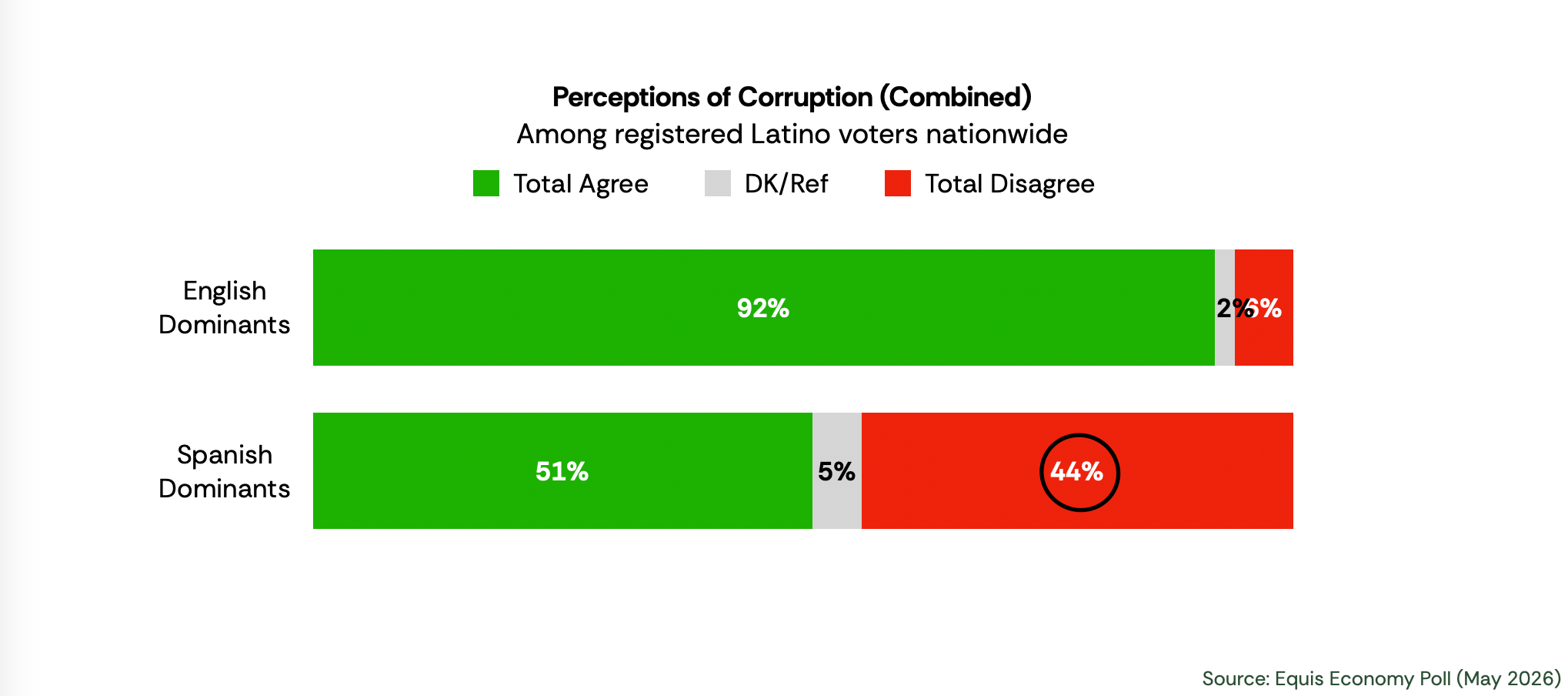
While we’re not yet sure why there was such a significant difference in agreement among Spanish vs English dominants, this finding raised an important question about the effectiveness of corruption messaging in Spanish generally, especially given that "corruption is increasingly at the center of the 2026 election, with Democrats making it a core tenant of their midterm messaging" (NBC News). To answer that question, Equis decided to test the efficacy of four different economic messages in Spanish that paint a contrast between who Republicans and Democrats care about. One of the messages was focused on the economy alone, while the other three incorporated issue-specific proof points for Republican’s misplaced priorities, including corruption, immigration, and the war in Iran. The goal was to identify whether corruption proof points - embedded in a message that followed other messaging best practices - would successfully increase Democratic vote choice, as well as to understand how corruption proof points performed relative to other issues in Spanish.
The messages tested (complete messages can be found in the downloadable PDF with full results) use the Winning Jobs Narrative aspirational populism approach, as well as the “care framework.” The care framework communicates who each of the political parties cares more about (people like you vs a small, wealthy elite). Equis research has found the care framework to be especially effective at shifting vote choice.
Overall, we found that the Economy + War message and the Economy Only message both significantly increased support for Democrats in the generic congressional ballot for this year’s midterm elections. There is suggestive evidence that the Economy + Corruption message, as well as the Economy + Immigration message, would increase Democratic vote choice, but they did not reach the same level of statistical significance as the other two messages.
The research reveals two key recommendations for Spanish economic messaging this cycle:
1. Combine the economy with other highly salient issues.
Equis polling from earlier this year found that a message that combined the economy and immigration outperformed a message on the economy alone. This research was done during the peak of the media attention on immigration enforcement, following the murders of Alex Pretti and Renee Nicole Good, when immigration was highly salient for Latinos (31% named it as a top issue in February vs 10% in May). The results of this message test show that a message that combines the economy and the war in Iran is highly effective at increasing support for Democrats. The war in Iran is currently the number two issue for Latino voters (13% name it as a top issue), second only to the economy and cost of living (52% name as a top issue) – and we know increases in gas prices because of the war in particular have been a major concern for voters. Taken altogether, this data suggests that talking about people’s top issues – in a way that tells a consistent story about who the parties do and don’t care about – can be an effective way to increase support for Democrats.
2. De-prioritize corruption messaging in Spanish.
The May economy poll revealed a significant difference between Spanish-dominants and English-dominants in their views of corruption in the US. The economic message in this test that incorporated corruption proof points did not significantly increase support for Democrats (using a 95% confidence interval). While the results are suggestive, the message did not perform as well as the Economy + War or Economy Only messages. Corruption messaging seems to have some complexity for Spanish-dominants that we don’t fully understand yet. There are also many ways to frame or incorporate corruption in messaging that we did not specifically measure here. For these reasons, we recommend de-prioritizing corruption messaging in Spanish until more research can be conducted. Instead, use the Economy + War or Economy Only messages as a model for effective economic midterm messaging in Spanish. Develop messages that focus on voters’ top issues in a way that demonstrates who the parties do and don’t care about.
1Respondents who reported being able to carry on a conversation in Spanish “very well” or “pretty well” and “just a little” or “not at all” in English.
We work toward a more sophisticated understanding of the experiences, issue preferences, and political identities of Latino and Hispanic voters.

Equis is a set of organizations working to create a better understanding of Latinos, innovate new approaches to reach and engage them, and invest in the leadership and infrastructure for long-term change and increased engagement.